
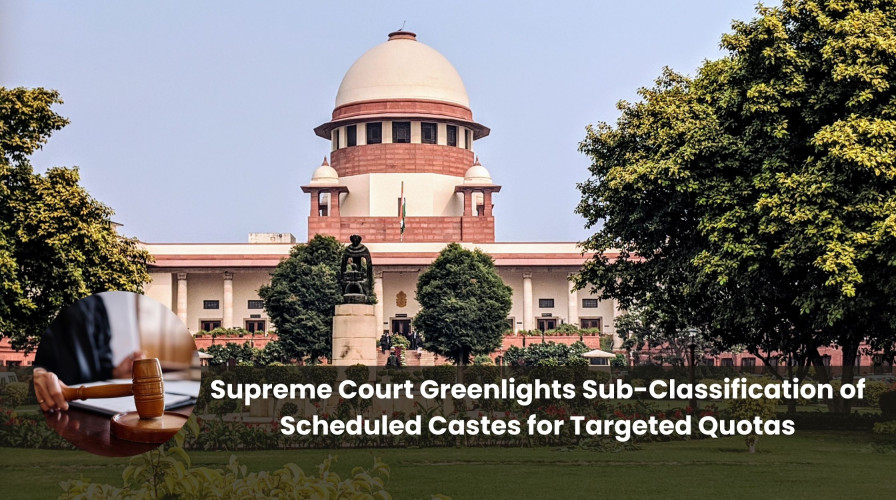
Supreme Court Greenlights Sub-Classification of Scheduled Castes for Targeted Quotas
In a landmark decision, the Supreme Court has ruled that state governments can sub-classify Scheduled Castes (SCs) and Scheduled Tribes (STs) to better target reservations in education and public employment. This decision overturns the 2004 E.V. Chinnaiah verdict and aims to address the varying degrees of backwardness within these communities.
Majority Ruling
A seven-judge Bench, led by Chief Justice of India D.Y. Chandrachud, delivered a majority judgment in favor of sub-classification. The court held that SCs and STs are not homogeneous groups and that sub-classification would not violate the President's authority under Article 341 of the Constitution. This ruling supports the idea that states can provide greater benefits to more disadvantaged sub-groups within the SC/ST communities, provided they base their actions on empirical data.
Justification and Conditions
Chief Justice Chandrachud emphasized that sub-classification must be supported by quantifiable data showing the inadequacy of representation of certain sub-groups. States cannot make arbitrary decisions; their actions are subject to judicial review. The court also upheld the legislative competence of the Tamil Nadu Assembly to enact the Arunthathiyar Reservation Act, which provides specific quotas for certain sub-groups within the SC category.
Opinions from the Bench
Justice B.R. Gavai, in his separate opinion, highlighted the need for a policy to identify the "creamy layer" within SC/ST communities. He argued that individuals who have benefited from reservations and achieved affluence should no longer be eligible for these benefits, thus making room for more deserving candidates. Justice Gavai stressed that this approach aligns with the principle of true equality enshrined in the Constitution.
Justice Vikram Nath and Justice Pankaj Mithal agreed with the Chief Justice and Justice Gavai, supporting the idea of identifying a creamy layer among SC/STs to ensure that the benefits of reservation reach those who need them most.
Dissenting Opinion
In a dissenting note, Justice Bela M. Trivedi argued that states should not interfere with the Presidential List of Scheduled Castes. She maintained that the SC community is a homogenous group and that any preferential treatment within this group would violate the intended purpose of reservations. Justice Trivedi warned that allowing states to sub-classify SCs could lead to political manipulation and undermine the integrity of the reservation system.
Background and Legal Context
The decision to allow sub-classification revisits and overturns the 2004 E.V. Chinnaiah verdict, which held that SCs and STs are homogenous groups and cannot be further sub-divided for reservations. The current ruling acknowledges the diverse degrees of backwardness within these communities and seeks to address inequalities more effectively.
Impact and Implications
This ruling has significant implications for the reservation system in India. It allows for a more nuanced approach to affirmative action, ensuring that the most disadvantaged sub-groups within SC/ST communities receive the support they need. However, it also raises questions about the implementation and monitoring of such sub-classifications, highlighting the need for robust empirical data and judicial oversight.
Conclusion
The Supreme Court's decision to permit sub-classification of Scheduled Castes and Scheduled Tribes marks a pivotal shift in India's reservation policy. By recognizing the heterogeneity within these communities, the ruling aims to create a more equitable system that addresses the varying degrees of discrimination and backwardness. The challenge now lies in ensuring that this approach is implemented fairly and effectively, benefiting those who need it most.
Related Tag :